Being the second novel in Steven Erikson's epic fantasy series, "The Malazan Book of the fallen", this novel follows on where the first novel "Gardens of the Moon" left.
There are several threads of tale happening in parallel
being narrated in this book. The Seven cities is in the brink of rebellion, .
The Malazan Empress Laseen had ordered a cull in nobility, with many nobles being sent
to Otataral mines.
Spoiler Alert...
Felisin Paran of the House of Paran, Baudin
and Heboric are being sent to Otataral mines. Baudin, a talon assassin is sent
by Adjunct Tavore (Felisin’s sister)to
protect Felisin. Felisin doesn’t know and blames her sister for the murder of
their parents.
The seven cities rebellion, known as the whirlwind led by
the prophetess Sha'ik from the Holy Desert of Raraku.
Fist Coltaine, the takes command of Malazan 7th
army against the seven cities rebellion and orders to escort the Malazan
refugees to Aren. He starts the long
journey with refugees and rebel armies tailing him.
Fiddler, Kalam, Crokus, and Apsalar (formerly Sorry),
following the events of Gardens of the Moon, land in one of the seven
cities, to return Apsalar to her village. Kalam makes a contact with one of the
rebels and agrees to delivers Dryjhna’s Holy Book, which will unleash the
rebellion’s Apocalypse, to Sha’ik in Raraku. Kalam is tailed by a Red Blade
captain, Lostara Yil, who kills the Sha’ikafter Kalam leaves.
Meanwhile Felisin, Baudin and Heboric escape from Otataral
mines. Baudin sacrifices his life while saving Felisin. Hood takes Baudin in
flesh? Felisin and Heboric reaches the oasis where Shai’k is murdered. Felisin
opens Dryjhna’s holy book taking the goddess into her body. Felisin becomes the
Shai’k reborn.
Lostara Yil tailing Kalam meets Pearl, mage in Claw. Kalam
plots to kill the empress, but changes his mind, after having an audience with
Empress Laseen. Kalam escapes from a claw onslaught, Shadow throne takes Kalam
and Minala (one whom Kalam rescues) to his new warren - The warren of the Shawdow
The “One minute Manager” has sold over 13 million copies and translated into 37 different languages (source: wikipedia). This book has been written in 80's, its concepts definitely holds good even today.
The book begins with a story of an young man trying to find an effective manager, all he finds are either “tough” managers who focus onto results, or “nice” managers who focus onto people. Both categories did not qualify for effective manager. Then the young man met the “One minute Manager” who was tough and nice at the same time. The learning’s given in the book are the conversations happened between them.
According to the book the three secrets of One Minute Manager are:
1)One Minute Goal Setting.
·The employee submits his set of goals (one goal per sheet) to his manager.
·The goals require one minute to read out, its checked and evaluated everyday by the employee.
2)One Minute Praising.
·When an employee does something right, he is praised immediately.
·The employee is encouraged to do more of the same.
3)One Minute Reprimand.
·When an employee makes some mistake, they are reprimanded for a minute.
·Make the employee realize that, when the reprimand is over, it’s over.
·The employee is reminded, how valuable they are for the organization.
One of best quote from the book “People Who Feel Good About Themselves Produce Good Results”.
I would recommend this book to all the budding managers out there.
“Gardens of the Moon” is the first
novel from the series “Malazan Book of the fallen” by Steven
Erikson. Steven Erikson is an Canadian novelist, whose real name is
Steve Rune Lundin.
“Malazan Book of the fallen” is one
of the best epic fantasy series of recent times. Currently the series
has ten volumes published. The story doesn’t revolve around a
central character, it has a mass of characters. The fictional Malazan
world was originally created by Steven Erikson and Ian Cameron
Esslemont for a role-playing game.
The fictional world is dominated by
Malazan empire with its huge armies, keeps on expanding its
territories by conquering all the known land masses. Malazan empire
was ruled by Emperor Kellanved, who was assassinated. Empress Laseen
rules with the help of “claws” a group of imperial assassins.
The story starts with Malazan 2nd Army
under High Fist Dujek is besieging the city of Pale, one of only two
Free Cities left in the Malazans'
path in continent Genabackis .
Pale is holding out due to alliance with the powerful Anomander Rake, Lord of Moon's Spawn (a floating fortress),
leader of the non-human Tiste Andii (Tiste Andii were invaders from another world).
Sergent Whiskeyjack, Sergeant of
Bridgeburners ( a highly acclaimed and well respected company) tasked
with tunneling under the walls of Pale, looses out his entire company
of soldiers when the tunnel collapsed except for 30 odd soldiers.
Lorn, adjunct to the Empress sends Captain Ganoes Paran to be the new
captain of Bridgeburners. The Empress aim is to destroy Sorry, an new
recruit in Bridgeburners, who is possessed by Cotillion (an Ascendant
of High House Shadow, the patron god of assassins). To do so, she
plans to destroy the whole company of Bridgeburners by giving them
impossible missions and back-stabbing them whenever possible. Even
the collapse of the tunnel they were working on was considered to be
the work of Empress.
The Empress Laseen sends Imperial High
Mage Tayschrenn to destroy Anomander Rake and take over Pale.
Tayschrenn and other Mages with 2nd army attack Moon’s
Spawn drawing out Anomander Rake. Anomander Rake unleashing great
waves of magic thereby destroying most of the 2nd Army,
while Tayschrenn contributed by killing his fellow mages in the
mayhem. Moon’s Spawn having received great damages retreats from
Pale, thus allowing 2nd army to seize Pale.
Sergent Whiskeyjack and remaining
Bridgeburners are tasked to infiltrate Darujhistan (which is the only
remaining free-city) and sabotage to weaken its army before the
Malazan army reaches Darujhistan.
Meanwhile, Moon’s spawn is seen above
Darujhistan, Anomander Rake forges alliance with T'orrud Cabal (a
powerful group in Darujhistan headed by Baruk).
Lorn with Onos T'oolan ( a T’lan
Imass) travels to Darujhistan with another agenda, ie. To set free a
tyrant Jaghut ( T’lan Imass and Jaghut are primeval beings of
malazan world with great magical powers) who is imprisoned for
eternity within great barrows in Darujishtan . Their plan is to set
free this tyrant, and Anomander Rake will have no option to face this
jaghut. If Anomander Rake manages to destroy tyrant Jaghut, it will
weaken him considerably for Malazan forces to destroy Rake easily.
What happens next? Will Lorn free the
tyrant Jaghut? Will Darujhistan fall to Malazan? You gotta read
the book.
With too much characters, sometimes one
has to go back and check who is this character and how did he reach
here. With Gods, and semi-Gods, with magic “warrens” that wizards
draw their power from, it is a work of great skill and beauty.
"Ptolemy’s Gate", is the third and final book in the "Bartimaeus Trilogy" by Jonathan Stroud. With this final book, the trilogy comes to an end in excitement, adventure and an unexpected turn towards tenderness and true values.
A little background: Nathaniel (known as John Mandrake) helped saved the ministry twice, once from Lovelace & Ramuthra and next from the marauding Golem. He is now an established member in the British government. He had let Kitty Hawk (from resistance) scott free. The resistance has been dismantled.
Plot:
Things were not looking good for British Government. Foreign wars are going badly. Many commoners are unhappy with the current government, and rebellion is fermenting among them. Nathaniel is friendless and constantly watched by enemies. He has become merciless and treats everyone cruelly, especially Bartimaeus.
Kitty Hawk finds a job with a retired magician as his helper. She ponders on the reason on why humans and spirits are locked in endless struggle. She understands that humans (magicians) summons spirits and make them slaves; they fear spirits and consider them dangerous. So they keep them in shackles and as slaves and never treat them as equals.
Bartimaeus had told her that his greatest master, Ptolemy, was the only human who treated his servants as equals. Ptolemy falsely believed that other people would follow his footsteps. Ptolemy trusted Bartimaeus and even crossed over to the “Other Place” with Bartimaeus and came back alive. The “Other Place” is where spirits dwell.
Kitty’s aim to learn some magic as to summon Bartimaeus and travel to “Other Place”. After putting some effort, she succeeds and travel to “Other Place” with Bartimaeus, the only person other than Ptolemy to do that. Thus earning full trust from Bartimaeus.
Farquarl (a Djinn mentioned in “The Amulet of Samarkand”) and his friends (spirits) are plotting to destroy the magicians and take over the human world. Their plan is to lure magicians to share their bodies to spirits for promises of greater power. Once inside magician’s bodies, they can take full control of their body and mind and then rule the world. Farquarl and Nouda (an entity of greater power than Madrid) manage to enter into human bodies (magicians) and starts unleashing havoc. Soon they create an army of hybrids (spirits & humans). Nathaniel escapes and decides to destroy Nouda. It can be done only if he wielded the Gladstone’s staff, but he doesn’t have the power to wield and use the Gladstone’s staff.
Nathaniel and kitty decides that only if Nathaniel and Bartimaeus combines, together they can wield and use the power of Gladstone’s staff to destroy Nouda and his hybrid army. Bartimaues agrees, even when he suspects that he too will get destroyedin the attack. Finally they combine, sets out to destroy Nouda.
Do they finally defeat Nouda and his army of hybrids, and rescue the world? Does Nathaniel and Bartimaeus survive the attack? That’s the suspense, you get to uncover by reading the book.
Ptolemy’s Gate is an excellent ending to the “Bartimaeus Series”. It’s a brilliant story, with unexpected twists and turns in plot. A must read.
"The Golem’s Eye", is the second book in the "Bartimaeus Trilogy" series by Jonathan Stroud.
It is an excellent sequel to the first book in the series, “The Amulet of Samarkand”. If you have not read “The Amulet of Samarkand”, I strongly recommend you get a hold of that one before reading “The Golem’s Eye”, or you will miss a lot of background. You can read my blog about “The Amulet of Samarkand” here.
The story begins two years after the events of “The Amulet of Samarkand”. Nathaniel is apprenticed to the Minister of Security – Jessica Whitwell, he is also working as an understudy to the Minister of Internal Affairs – Julius Tallow. Nathaniel is fourteen years old, a complete magician and now a government official. Now he is known as “John Mandrake”.(do you remember Mandrake, the magician ;-) London is rocked by small attacks by a group of rebels called “The Resistance”. Nathaniel is investigating the case. He knows three names – Kitty, Fred, and Stanleyfrom a previous encounter in “The Amulet of Samarkand”, when they stole his scurying glass. He tries find them but to no avail.
“The Resistance” consists of magic resistant commoners. They are immune to most of the magical attacks and can see through illusions created by Djinns. Bartimaeus thinks this might be because too much of magic is flowing in and around London for centuries, and some of the newborns are born with natural resistance to magic. These people who hated magicians have grouped together for a common cause ie. downfall of magicians. Currently, the main activity of “The Resistance” is to rob the houses and establishment of magicians and collect the magical items as much as possible. Their leader is studying the use of these magical items, and their ultimate aim is to use them against the magicians.
Soon there were different type of attacks in large scale, properties destroyed. Anyone including spirits, who are near the incident is being killed. The attacker is always concealed in a mist. The government suspects “The Resistance” for these activities and is getting restless. The Prime Minister orders Nathaniel to put a stop to “The Resistance”. Nathaniel suspects “The Resistance” capability to launch such destruction. After several failed attempts to summon other spirits, he summons Bartimaeus again and charges him find the unknown attacker.
[Since Bartimaeus knows Nathaniel’s birthname, he could have easily destroyed Nathaniel …. Don’t know why he doesn’t do so. Maybe that’s why it worked in a smooth partnership, with both having equal power over other.]
Bartimaues joins with his old friend Queezle, and hunts for the mysterious attacker. Queezle meets the attacker and gets killed by it. Bartimaues arrives too late, gets nearly killed by it, but was able to remove the concealing mist surrounding the attacker. Bartimaues informs the government that it was a golem who attacked. Soon Nathaniel is sent to Prague to find out the secret of Golem.
Meanwhile “The Resistance” plans to raid Gladstone’s tomb and take valuable magical artifacts. They were secretly assisted by a mysterious informant on how to evade the magical security put in place, provided they give him the Gladstone’s staff. Gladstone was the first magician Prime Minster of England and was a very powerful magician. He had single handedly won many wars for England. As they loot the tomb, a ninth-level afrit named Honorious appears who is trapped inside the Gladstone’s bones. Honorious kills most of the members using a sword, but kitty escapes with Gladstone’s staff. The Gladstone’s staff is the most powerful artifact in the tomb, but unknown to Kitty. Kitty goes into hiding, not knowing how many members are left alive.
Nathaniel travels to Prague and finds out magician Kavka, who knows the secret of Golem. The Golem is actually a clay beast, with a magical animation manuscript inserted in its mouth, and it can be controlled using a golem’s eye. Kavka destroys the manuscript he was creating for the unknown person and dies in the resulting explosion. Nathaniel returns back to England, failing to get the info on who’s controlling the golem.
Meanwhile Honorious inside the Gladstone’s skeleton started terrorizing London. Nathaniel asks Bartimaeus to take care of Honorious. Bartimaeus manages to drown Honorious in Thames. Nathaniel decides to acquire the Gladstone’s staff from Kitty to destroy the golem, forces Kitty to come to a secret location, by kidnapping her friend Jacob. Kitty Jones arrives, but gets attacked by the night police, Nathaniel angry at the night police intervention, orders Bartimaeus to rescue Kitty. Bartimaeus rescues Kitty and hid in an old abandoned building, the one in which Bartimaeus and Nathaniel takes refuge in the “The Amulet of Samarkand”. Bartimaeus and Kitty have an interesting conversation, they discuss about magicians and spirits and their endless struggles. This changes Kitty’s views on spirits and she decides to know more about spirits and their realm.
Kitty and her friend Jacob, take Nathaniel to cellar where the staff is hidden. Suddenly, Honorious appears there and attacks (as he is trying to recover all the stolen artifacts of Gladstone). During the mayhem, the Golem also appears there. Honorious attacks the Golem headlong and but gets destroyed by the Golem. Nathaniel tries to use the staff against Golem, but Nathaniel is not strong enough to wield the staff and fails, and gets knocked unconscious. Kitty and Jacob were about to flee, but Kitty then decides to help Nathaniel, when she sees the Golem turning to attack Nathaniel. Kitty boldly climbs over Golem and snatches the magical parchment from its mouth, which destroys the Golem. Then Kitty and Jacob flees the scene.
The Golem when destroyed goes back to the master who’s controlling him. Nathaniel gets up and follows Golem. Golem returns to Henry Duvall, the Chief of Night Police. Henry is arrested, but tries to escape prison and gets killed a few days later. The person behind Henry Duval remains a mystery to Nathaniel.
Kitty Jones has been given more importance in this novel. Her background is explained, and how she starts to hate magicians and spirits. But her conversation with Bartimaeus, brings her closer to understand the spirit world, changes her perception towards spirits. Kitty, herself did leave a small bit of influence on Bartimaues. Bartimaues also explains her, how he once liked Ptolemy and how Ptolemy trusted him and even traveled with him to spirit world and returned.
The novel retains all the strength’s of the “Bartimaues trilogy – Book 1”, and a must read if you liked "The Amulet of Samarkand". The sequel to this book is “Ptolemy’s Gate”, the final book in The Bartimaues trilogy.
"Dragonfly Falling” is the second volume in the Shadows of the Apt series by Adrian Tchaikovsky. You can read about his debut novel “Empire in Black & Gold”here.
The Amulet of Samarkandpublished in 2003, is the first book in the Bartimaeus Trilogy by Jonathan Stroud. One of the several writers who have stepped into Harry Potter bandwagon, with stories of magic and magical creatures,but Jonathan Stroud stands out of the crowd and brings us to a totally different world on its own with his Bartimaeus Trilogy.
The story is set in an alternate London, where its entire government is made up of magicians. Non-magicians known as "commoners", live in fear and awe of magicians. The magicians possess little magic on their own, but they know how to control entities or demons which perform magic for them. The stronger they are, the more powerful demon they are able to summon. The demons are classified according to their power - Marids, Afrits, Djinn, Foliots and Imps. It is explained that there are huge classifications below Imps, but they are largely unused, and several classifications that are more powerful than Marids but are hardly ever used due to the extreme danger in doing so. The Demons are usually evil entities, and are forced to obey their masters as slaves. So it is pretty common that they harm their master if they get a slight chance.
Magicians are never allowed to have children, they adopt young children of commoners who shows promise in magical capabilities, take them into apprenticeship and teach them the ways of magic. As the children were removed from their parents, knowing no love, they grew into cold-hearted selfish magicians, who lusts for great power and position.
The story is narrated through two different points of view, one from Nathaniel and one from perspective of an ancient, sarcastic, and extremely humorous Djinni, Bartimaeus.
At the age of six, Nathaniel's parents sold him to the government, and he was assigned as apprentice to Arthur Underwood and his kindhearted wife Martha Underwood. Nathaniel, a brilliant student, under a middling and heartless magician grows impatient with his master’s way of teaching.
At the age of ten, in a gathering hosted by his master, Simon Lovelace (the antagonist) humiliates him. Vowing revenge, Nathaniel studies harder and educates himself more than this master knows, by studying the books from his master's study. At the age of twelve, Nathaniel secretly summons an ancient (5000 year old) and powerful Djinni Bartimaeus and charges him to steal an artifact (The amulet of Samarkand) from Simon Lovelace, which he has seen through his magical rudimentary scrying glass (used to spy on someone).
What Nathaniel doesn’t know, is that Lovelace has himself acquired this artifact through treachery and has some grand plans to use it for his own political growth, and would go to any lengths to retrieve it.
Bartimaeus completes the task under great difficulty, fighting Farquarl and Jabor, two powerful djinns under Lovelace's command. Fighting a gang of "magically resistant" boys called the "Resistance" in an alley, when they attempted to steal the amulet from Bartimaeus. Nathaniel summons back Bartimaeus and orders to hide the amulet in Underwood's study for safekeeping. Bartimaeus learns boy's birth name "Nathaniel" when Mrs. Underwood calls him. The birth names of magicians are kept secret, ifknown can be used against the person. Knowing Nathaniel's birth name, Bartimaeus repels all his spells.Nathaniel counteracts this with a “Perpetual Confinement” spell on a sealed tin of rosemary, which guarantees Bartimaeus’ servitude for one month, and the safety of Nathaniel. If Nathaniel is killed by any means, Bartimaeus will be confined in the tin of rosemary (torture to Djinns) for eternity and drowned in Thames.
Nathaniel later charges Bartimaeus to spy on Lovelace and find out more about the "amulet of Samarkand". Bartimaeus finds that the amulet was under government protection, before it was stolen. Bartimaeus was soon captured and confined in "Tower of London" where he was interrogated unsuccessfully. Nathaniel without knowing this tried to summon him several times, but in vain. Underwood accidentally discovers summoning pentagon in Nathaniel’s room, flews into rage (a 12 yr boy shouldn’t know how to summon) and confiscates the summoning equipments.
Meanwhile Jabor and Farquarl arrive at Tower of London, and helps Bartimaeus to escape, assuming Bartimaeus will reveal the location of amulet and his master. But Bartimaeus knows that any harm to his master is also his doom (Perpetual Confinement in a tin of rosemary), he escapes by igniting Farquarl. Bartimaeus returns back to Nathaniel, but unknowingly followed by Lovelace's imps.
Lovelace soon arrives at the Underwood's house and finds the amulet in the study. Nathaniel sensing danger to Mr.and Mrs. Underwood, reveals himself as the thief. Mr. Underwood then betrays Nathaniel by asking Lovelace to kill Nathaniel and spare his own life. But Lovelace summons Jabor to destroy all the three and the house. But Bartimaeus escapes with Nathaniel, but Mr and Mrs Underwood perish.
Nathaniel vows for revenge for his beloved Martha Underwood's death and promises Bartimaeus, his freedom after this final task. Together they travel to Heddlehem Hall, where Lovelace has invited all the members of the parliament and plotting to capture power. The pair arrives disguised as a delicatessen and son and they see Farquarl present in the kitchen at the hall.
Bartimaeus gets engaged in a fight with the Bearded Mercenary (who possess extraordinary resistance to magic), and although he fails to defeat the mercenary, he is able to escape and meet up with Nathaniel. Meanwhile Nathaniel is discovered by Lovelace and his master Schyler, and is offered to join them or die. Nathaniel manages to kill Schyler using petty magical cubes.
Bartimaeus and Nathaniel arrives in the Hall just in time. The great hall where all the members were seated was magically sealed shut and floor contained a huge pentacle (used for summoning). Lovelace then blows an ancient summoning horn and calls forth an immensely strong entity - Ramuthra. Ramuthra proceeds to warp reality on seven planes killing the nearby magicians and djinns.The amulet of Samarkand is the only artifact that can protect anyone from a spirit as strong as Ramuthra,and Lovelace is wearing it on his neck.Bartimaeus destroys Jabor by tricking him to fly towards Ramuthra, and then steals the Amulet of Samarkand from Lovelace, and gives to Nathaniel. Without the amulet,Ramuthra (spirit above a Madrid) Lovelace is helpless, gets destroyed by Ramuthra. Nathaniel seizing his chance, speaks the words of dismissal and cracks the summoning horn, and dismisses Ramuthra. Nathaniel then presents the amulet to the Prime Minister Rupert Devereaux.
The government hushes up the whole incident, but Nathaniel becomes a silent hero of the government. Rupert Devereaux appoints theMinister of Security, (Jessica Whitwell) a powerful magician to take Nathaniel into apprenticeship. Bartimaeus is dismissed, before leaving, Bartimaeus warns the boy against becoming a typical wicked power-hungry magician.
The focus in this story is Bartimaeus, who is an amusing and sarcastic narrator, the hilarious way he narrates the way of magic and also his exploits in the past, is an absolute joy to read. The footnotes given by Bartimaeus, of what he thought of each situation, or criticizing others, a new method of writing, without actually affecting the storyline.
Bartimaeus is framed as a good Djinni, but there’s never an emotional attachment between Nathaniel and Bartimaeus. I felt attached to Bartimaeus, but not to Nathaniel, who remains cold throughout the novel.
The novel is little darker than the Harry potter series, entangled in politics of the ministers carving for greater power. The book is a great follow-up if you happen to finish the Harry Potter series. There’s a movie being made on this novel.
Empire in Black and Gold is the first volume of the fantasy series Shadows of the Apt by Adrian Tchaikovsky.
Adrian Tchaikovsky is a Pen name, real name being Adrian Czajkowski (Czajkowski - difficult to pronounce, right? That's exactly why, he used a new pen name). Like other fantasy stories, there are no elves, orcs, dragons, trolls, dwarfs or "normal humans". Instead, this excellent debut fantasy is set in a quite unusual fantasy world of various human races who long ago adapted to prehistoric insects and are called "insect-kinden" like ant-kinden, beetle-kinden, mantis, dragonfly etc. (Insect-Kinden??? Instead I would have personally preferred animal-kinden, like wolf-kinden, tiger-kinden, bear-kinden ... more cool right?). For more information click here.
Well, each insect-kinden species has their own unique power, or ‘art’ that resembles the insect they represent.
Different types of Art (only for the main characters):
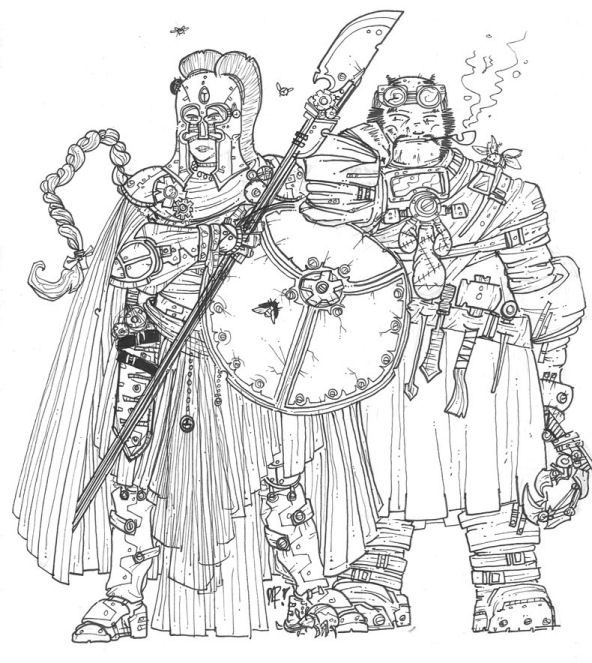
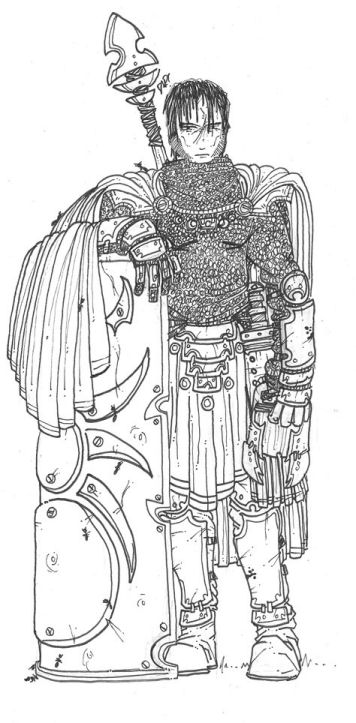
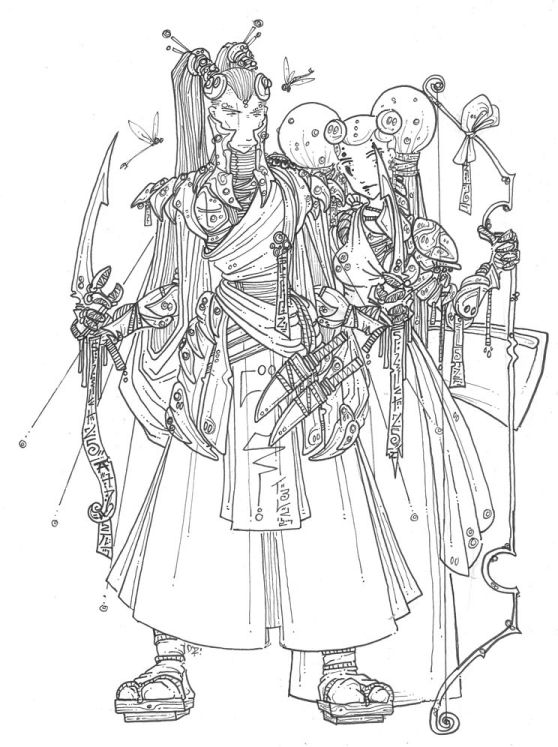
Beetle-kinden: Natural Engineers. They build all kinds of machinery. Not good fighters or fliers. Most of them are highly educated. The main protagonist in the novel is a Beetle-kinden. A sketch of Beetle-kinden.
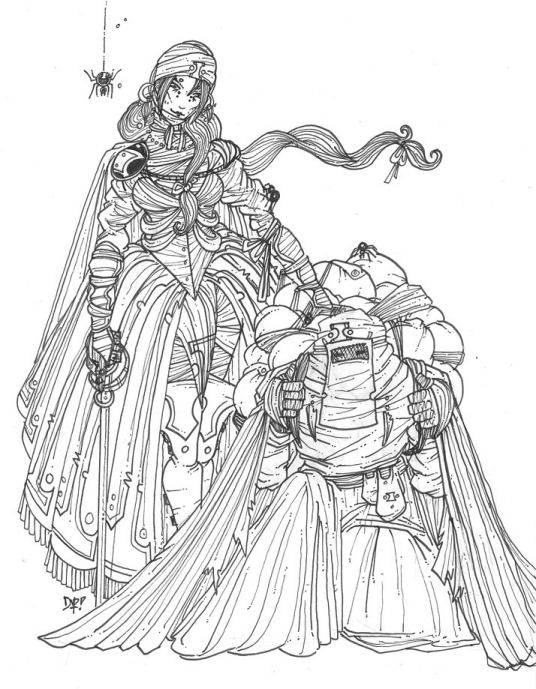
Spider-kinden: Tricky, untrustworthy, dominated and ruled by women. They are good-looking and charm their way past most people. link
Ant-kinden: All are fighters/hardworking and telepathically linked with their kind. link
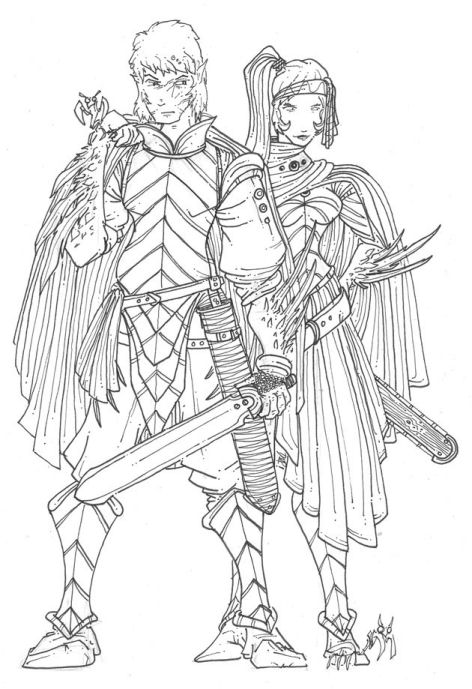
Mantis-kinden: Have bony spines on their arms and are deadly skilled fighters. No other race can match them with their skill with weapons. Good eyes to see in dark. A sketch of Mantis-kinden.
Dragonfly-kinden: Proud race and good fighters. No race can match them in a fight in sky. Can see very well in the dark. link
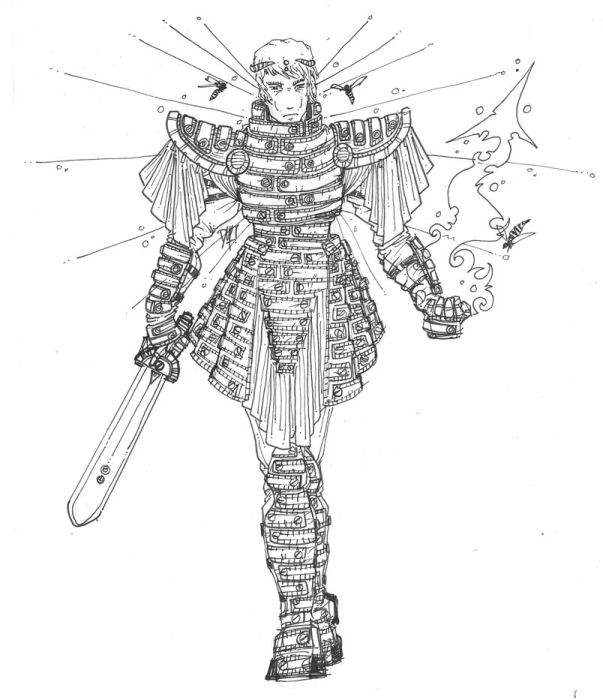
Wasp-kinden: The main antagonists in the story. Wasp-kinden doesn’t do anything (work) other than fighting. Every male wasp is in army and leaves other work to their slaves. Their killing art - can shoot energy balls from their palms, which blasts and burns on contact (according to author, similar to a wasp’s sting). A sketch of Wasp-kinden.
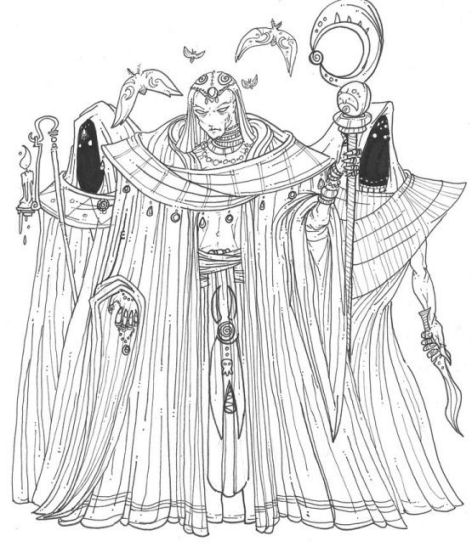
Moth-kinden: once rulers of the free states with mantis-kinden. Hates and doesn't understand machines. Knows magic and loves nature. link
Half-breeds: The insect-kinden normally don't interbreed. If they do, the resulting offsprings are known as Half-breed and are despised by all the other pure breeds.
The Empire of Wasps is expanding their empire with its highly trained armies (their army uniform being black and gold), war machines and its killing Art (wasp-sting). They are currently at peace after war with Commonweal states ruled by Dragonfly-kinden. Collegium and Helleron are technologically advanced free city-states of Lowlands ruled democratically by beetle-kinden. They flourish by trading machines, weapons to other city-states and even to Empire of Wasps. The Empire of Wasps is the biggest trade partner of Helleron. The city-states don't have an army of their own, but have paid mercenaries to do the job. They believe in peace and just earning wealth through trading.
The story revolves around Stenwold Maker (beetle-kinden), his students - his niece Cheerwell Maker (beetle-kinden), his ward Tynisa (spider-kinden?), the apprentice artificer Totho (half-breed b/w beetle and ant), Salma Dien (a prince of dragonfly-kinden), his trusted friend and great fighter Tisamon (mantis-kinden).
Stenwold is a master-artificer in a college academy in Collegium. For last seventeen years he has been trying hard to warn people of lowlands about the threat posed by the wasps to the city-states. But those words fell into deaf ears and as greedy beetle-kinden merchants and power hungry politicians believed wasps to be their best trading partners, and nothing to gained by going against them. But Stenwold feared, in time wasps will invade free states with their own weapons. Stenwold has a string of spy network to gather news and prevent wasps to gain an upper hand. Now wasps have started moving their own spies obliterating Stenwold's network. Stenwold knew that the time has come, he was forced to send his beloved students as reinforcements to Helleron from where the attack would come.
In the industrial city of Helleron, everything goes awry and the four friends gets separated. Salma and Cheerwell gets captured by Wasps and were taken deep into enemy territory. Stenwold, Tisamon, Tothoand Achaeos(moth-kinden) (once rescued by Cheerwell) regroup for the rescue. They track down the prisoners, and rescue them. Their efforts were seriously hampered by a shape-shifter (hired by wasps) who can impersonate any person.
In enemy territory they learn about the plans on attack on Collegium. The wasps believe that by taking Collegium they can end any chance of the Lowlands uniting together against them. There is a new railroad being built between Helleron and Collegium with a state-of-art fast and powerful engine called Pride to pull the passenger compartments. It was technological break through, which everyone was eager to see it started. The railroad when finished would reduce the travel time to a couple of hours. The Wasps were waiting to use this railroad to mount a surprise attack on Collegium. Stenwold hatches a plan to destroy the engine, before it can be used. After a thrilling fight and with some luck, Stenwold and his friends managed to destroy the engine and cast suspicion on the Wasp-Kinden.
The story ends with Salma and Totho arriving at Tark (a ant city-state) to save a butterfly-kinden from slavery.
The novel is fast-paced and action driven. The author takes you to a ride in a fantasy world created by him. Politics, love, loyalty and betrayal converge in some delightful twists. A great fantasy highly recommended for reading.
The sequel to it is "Dragonfly Falling" (already published) and the "Blood of Mantis".
This is my first blog, let me start with the review of a novel I read recently - "The Rule of Four.
The Rule of Four is written by Ian Caldwell and Dustin Thomason, just after their respective graduation, published in 2004. WikiBaba (wikipedia;) says The Rule of Four reached the top of the New York Times Bestseller list, where it remained for more than six months. The book was a no. 1 national and international bestseller and has been translated into more than 25 languages.
Have you ever heard of Hypnerotomachia Poliphili? Neither did I, before reading this book.
Hypnerotomachia Poliphili (supposing this is how you should spell HY-NE-RO-TO-MA-KIA-PO-LI-FI-LI) was published/printed in Venice in 1499 by Aldus Manutius, who was a leading publisher and printer at his time. Do you know "Italic type" letters was first produced by Aldus Manutius. Hypnerotomachia Poliphili is written in Latinate Italian, Greek and even used Arabic and Hebrew words. It also contains some Egyptian hieroglyphics. The first letter in each chapter, if joined together reads in Italian - "Brother Francesco Colonna dearly loved Polia". So the author of Hypnerotomachia Poliphili is assumed to be Francesco Colonna, but still being debated among the scholars.
The Rule of Four is suspense thriller set on Princeton campus, and the plot revolves around this very mysterious, but real book. Two final year students, Tom and Paul, in Princeton Campus trying to solve the puzzle presented in Hypnerotomachia Poliphili. Tom, Paul, Charlie and Gil are undergraduate students in their final year, but pursuing different majors.
Tom Paul (a brilliant student) is writing his undergraduate thesis on the Hypnerotomachia Poliphili and spent all four of his undergraduate years studying the book. Tom is the son of a Hypnerotomachia researcher. Paul convinces Tom to help him out in his research. Tom agrees, as it was his father's dream, but his obsession on the book creates rifts in his personal life.
Vincent Taft and Richard Curry, being early researchers on this book and also being advisors for Paul in his thesis. Apart being academic rivals, Curry accuses Taft of stealing a diary written by a contemporary of Francesco Colonna's that Curry had found. That diary, as Paul and Tom discovered it later, would prove to help them to decode Hypnerotomachia. The story also revolves around the basement of the university which houses huge network of pipes, that carries heat to all parts of university. Also around the various eating clubs in Princeton campus, the top one being the "Ivy Club", of which Gil is the president.
Paul and Tom discovers Hypnerotomachia contains a number of hidden and encyphered texts. The encyphered text contains a riddle and the answer to the riddle is the key to decode each chapter. After solving several riddles and decoding corresponding chapters, the riddle stops with the saying that there no more clues for the rest because Francesco Colonna feared the secret falling in wrong hands. Later Paul realizes that the entire book is encoded by following a "rule of four", in which the message starts with one letter, then moves to a letter four rows down, then three columns right, then two rows up, then one column left (4,3,2,1), and repeating. Soon the duo unravels the mystery and the secret message.
The author of the Hypnerotomachia Poliphili, Francesco Colonna, was a humanist in Florence, and lived during the Renaissance period. [Renaissance means rebirth, Humanist - humanists would study ancient texts in the original, and appraise them through a combination of reasoning and empirical evidence. Humanist education being the study of five humanities: poetry, grammar, history, moral philosophy and rhetoric]. He was the son of a rich Roman noble. He loved knowledge, books, and arts. He had great passion for Greek and Roman literature. Girolamo Savonarola was the Dominican priest in Florence during that period. He felt the population were forgetting GOD were getting corrupted by embracing knowledge, art and literature. He asked his followers to gather forcibly books, painting and art, then conduct huge bonfires to burn them all. Collona was deeply disturbed and asked Savonarola himself to stop this, but was disappointed by the outcome. Collona decides that he shall save ancient books and arts as much as possible. He builds an huge underground vault for storing them. Collona used his vast resources to smuggle ancient books, arts from around Italy and stored them in the vault. The secret to the vault is saved in his work - "Hypnerotomachia Poliphili". Francesco Collona and two of his friends decided to become a martyr for this cause. When the bonfire was lit, they went into the bonfire and started pulling out the books, painting with their bare hands. Soon they perished in fire, but it triggered a major outcry against Savonarola, who was later executed.
Vincent Taft and Bill Stein (another of Paul's advisor) finding that Paul has progressed much in the research, decided to steal the work for themselves and claim the credit. Soon there is a string of murders, executed by Richard Curry to prevent this from happening. In a final struggle between Tom, Gil, Paul and Curry, a fire breaks out in Ivy eating club. Tom and Gil escapes from the fire, but Paul and Curry can't. Tom, Charlie and Gill are devastated as they believe Paul must have died with Curry in the fire....
After several years Tom received a tube with an painting, which was considered long lost. Tom realizes, his friend Paul is alive and have found Collona's vault. The painting is from the vault. The story ends with Tom packing up to travel to Italy.
What amazes, is the authors' in-depth knowledge of art and literature present during the Renaissance period. Combined with great imagination, fiery drama and suspense, no wonder this novel was national/international bestseller list for more than six months. This book has been well received by critics and some compared it positively to the Da Vinci Code.
I would recommend to read this book or just wait for some months for The Rule of Four movie to hit the theaters.
 Felisin Paran of the House of Paran, Baudin
and Heboric are being sent to Otataral mines. Baudin, a talon assassin is sent
by Adjunct Tavore (Felisin’s sister) to
protect Felisin. Felisin doesn’t know and blames her sister for the murder of
their parents.
Felisin Paran of the House of Paran, Baudin
and Heboric are being sent to Otataral mines. Baudin, a talon assassin is sent
by Adjunct Tavore (Felisin’s sister) to
protect Felisin. Felisin doesn’t know and blames her sister for the murder of
their parents.